
Commercial Solar Panel Cost Guide: Insights for 2026
As commercial energy costs continue to climb and sustainability becomes a strategic priority, understanding the commercial solar panel cost in 2026 is more important than ever. This guide offers clarity on what businesses can expect to pay, which factors drive pricing, and how to maximize returns on solar investments. You will find a detailed breakdown of cost components, current price trends, incentives, ROI analysis, and practical insights to help your business make confident, informed decisions in the evolving clean energy landscape.
Commercial Solar Panel Costs in 2026: What to Expect
The commercial solar panel cost landscape in 2026 is evolving rapidly, making it essential for businesses to understand where prices are headed, what drives them, and how to budget for a new installation. With the industry seeing significant advances and strong price competition, the time has never been better to consider investing in solar for your commercial property.
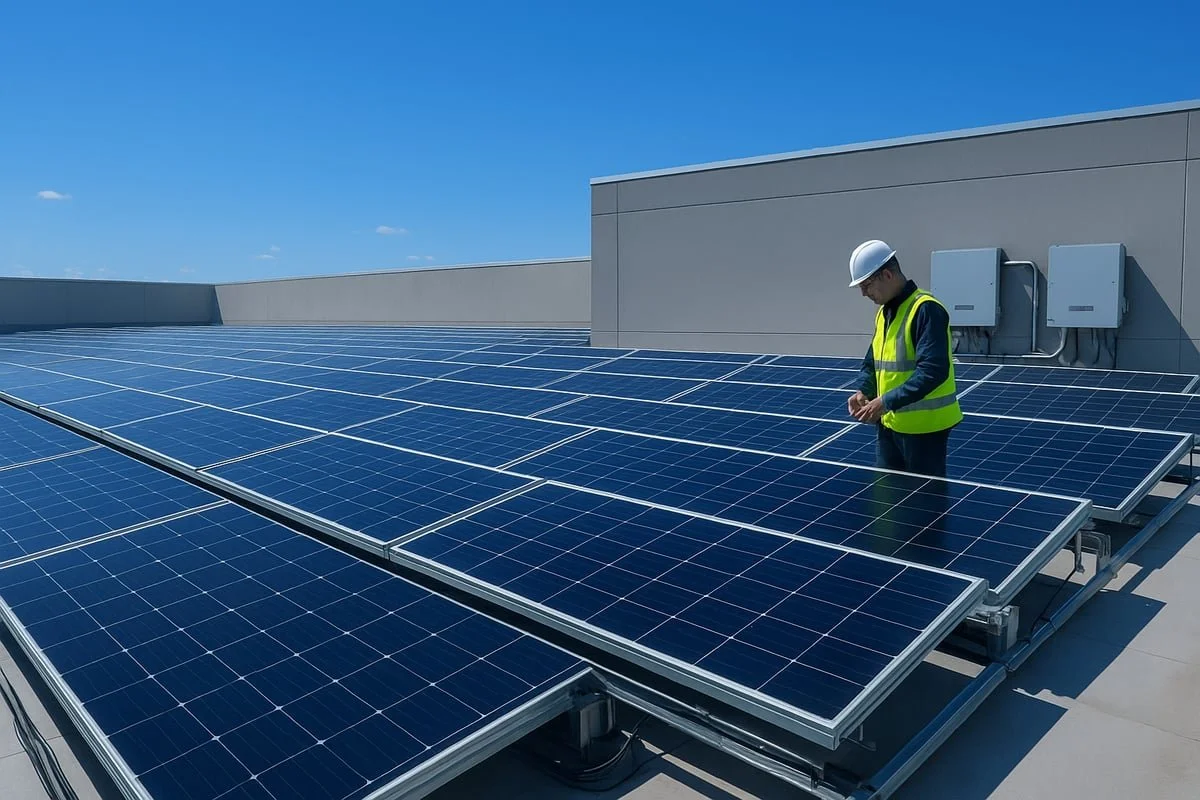
Commercial Solar Panel Costs in 2026: What to Expect
Average Cost Ranges and Per-Watt Pricing
In 2026, the average commercial solar panel cost is projected to be between $1.40 and $1.50 per watt (DC), reflecting ongoing declines driven by technology improvements and market competition. For most businesses, this means a typical 100kW system will range from $140,000 to $150,000, while larger 500kW installations may cost $700,000 or more, although bulk purchasing and economies of scale often drive the per-watt price lower for larger projects.
Here is a breakdown of estimated system costs by size:
| System Size | Estimated Cost (2026) | Per-Watt Cost (DC) |
|---|---|---|
| 100kW | $140,000–$150,000 | $1.40–$1.50 |
| 250kW | $340,000–$375,000 | $1.36–$1.50 |
| 500kW | $650,000–$750,000 | $1.30–$1.50 |
Several factors contribute to the commercial solar panel cost:
Solar panels (modules)
Inverters (string or central)
Racking and mounting systems
Labor and installation
Permitting and engineering
Soft costs (administration, project management)
Compared to 2024 and 2025, where a 12% year-over-year price decline was observed, 2026 continues this downward trajectory. The dramatic 35% drop in module pricing in 2024 has set the stage for even more competitive bids, making solar more accessible for a wider range of businesses.
Regional market conditions also influence commercial solar panel cost. Areas with higher competition among installers, favorable permitting processes, and strong state incentives can see lower prices, while regions with complex regulations or higher labor costs may experience above-average rates. For a detailed overview of system types and cost drivers, visit the Commercial Solar Systems Overview page.
Additional Costs: Maintenance, Cleaning, and Upgrades
Beyond the initial investment, businesses must plan for ongoing expenses that affect the total commercial solar panel cost over the system's lifespan. Regular maintenance and inspections typically run between $200 and $600 per year, ensuring optimal system performance and warranty compliance.
Cleaning services, which are recommended at least annually or more frequently in dusty environments, usually cost $10 to $30 per panel. Inverter replacements, a necessary upgrade every 10 to 15 years, can add $5,000 to $30,000 to your long-term budget. If your project includes battery storage for backup or grid independence, expect installation costs from $10,000 to $100,000, with additional maintenance fees over time.
Insurance premiums may increase to cover the added value of solar assets, so it is wise to confirm with your provider how your policy will be affected. Factoring in these additional elements ensures a realistic picture of your true commercial solar panel cost, helping you avoid surprises and maximize your investment.
Key Factors That Impact Commercial Solar Panel Cost
Understanding the key factors that influence commercial solar panel cost is essential for businesses aiming to make informed investment decisions. Each project is unique, and the final price depends on a range of technical, logistical, and market-specific variables. By examining these factors, companies can better estimate their true expenses and maximize their return on investment.
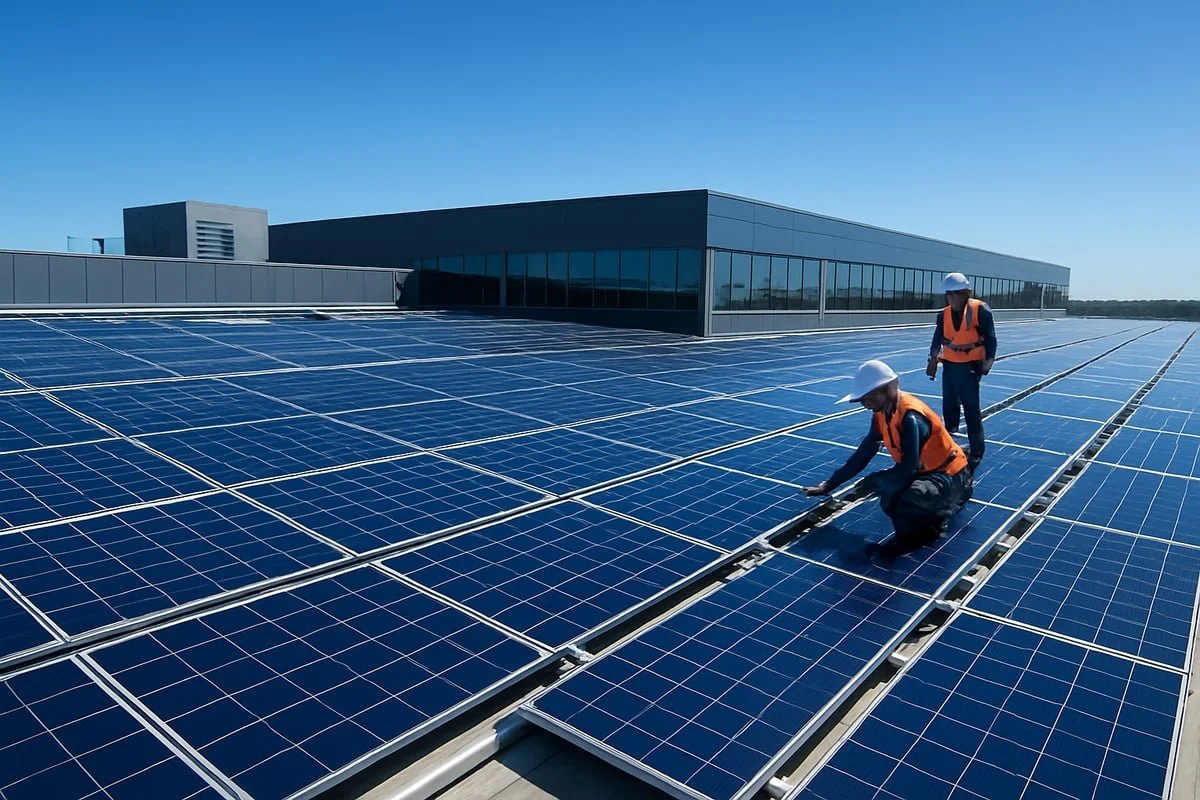
Key Factors That Impact Commercial Solar Panel Cost
System Size, Energy Needs, and Site Conditions
The size of your system is the single biggest driver of commercial solar panel cost. Larger systems generate more power and often benefit from economies of scale, which means the per-watt price can decrease as capacity increases. For example, a 100 kW system will typically have a higher per-watt cost than a 500 kW installation, even if the total expenditure is lower.
Energy requirements vary by business type. Manufacturing facilities with high, consistent loads may require larger systems than office buildings with fluctuating demand. Properly sizing the system to match your business’s actual energy consumption is key to optimizing both cost and performance.
Site conditions also play a pivotal role. Roof-mounted arrays are common for urban businesses, but ground-mount options may suit companies with ample land. Factors like available space, roof orientation, structural integrity, and shading from nearby buildings or trees all impact installation complexity and, ultimately, commercial solar panel cost.
A well-chosen site with minimal obstructions can reduce engineering and racking expenses, while challenging locations may require custom solutions, increasing costs.
Equipment Quality, Panel Efficiency, and Technology Choices
Equipment decisions significantly affect commercial solar panel cost over the system’s life. High-efficiency panels, while more expensive upfront, can deliver greater energy output per square foot and lower lifetime costs for businesses with limited roof space.
There are also choices in inverter technology. String inverters are cost-effective for large, uniform arrays, while microinverters offer module-level optimization, which can be advantageous for sites with shading or complex layouts. Microinverters generally increase commercial solar panel cost but can enhance system resilience and monitoring.
Battery storage integration is another factor. While not always necessary, batteries add flexibility and backup power, especially in areas with demand charges or unreliable grids. However, batteries can add significantly to the commercial solar panel cost.
Smart monitoring systems and advanced controls, though an incremental investment, provide real-time performance data and enable proactive maintenance, often resulting in operational savings.
Labor, Permitting, and Regulatory Compliance
Labor costs and regulatory requirements can swing the commercial solar panel cost by thousands of dollars. Labor expenses vary by region, depending on local wage rates and the availability of skilled installers.
Permitting, engineering, and interconnection fees are also highly variable. Some states and municipalities have streamlined processes, while others require extensive documentation and inspections. For instance, Florida’s permitting requirements differ from those in the Northeast, influencing both project timeline and commercial solar panel cost.
Compliance with building codes, fire safety regulations, and utility interconnection standards is mandatory and may require additional engineering or equipment adjustments. Delays or unexpected requirements can add to both direct and soft costs.
Careful planning and working with experienced installers can help minimize surprises and ensure that your commercial solar panel cost remains predictable.
Ongoing Maintenance and Warranty Considerations
Long-term performance and reliability hinge on both maintenance and warranty coverage. While solar panels are durable, regular maintenance is necessary to sustain optimal output and protect your investment. Annual maintenance contracts typically cover inspections, cleaning, and minor repairs, helping businesses budget for predictable expenses.
Insurance premiums may rise slightly with the addition of valuable solar assets, and eventual component replacements, such as inverters or batteries, should be anticipated in the total commercial solar panel cost.
Comprehensive warranties, spanning 25 to 30 years for panels and 10 to 15 years for inverters, add peace of mind. For a deeper look at maintenance needs and costs, visit Solar Panel Maintenance Essentials.
Choosing a reputable installer and securing robust warranties can minimize future repair costs and ensure the system’s value endures for decades.
Financial Incentives and Tax Benefits for 2026 Commercial Solar Projects
Securing the best commercial solar panel cost in 2026 requires more than just finding the lowest equipment price. Financial incentives and tax benefits can significantly lower total project expenses and accelerate return on investment. Understanding what is available, and how to claim each benefit, is essential for maximizing your savings.

Financial Incentives and Tax Benefits for 2026 Commercial Solar Projects
Federal Investment Tax Credit (ITC) and Changes for 2026
The Federal Investment Tax Credit (ITC) remains the most influential incentive for reducing commercial solar panel cost in 2026. Projects that begin construction before July 4, 2026, can claim a 30 percent ITC, which directly offsets federal tax liability. After this date, the ITC is scheduled to begin a phase-out, making timing crucial.
Three additional 10 percent “adders” can further increase savings if your project meets criteria for domestic content, low-income communities, or energy communities. Savvy businesses use safe harboring strategies, such as making a minimum investment or taking delivery of equipment, to lock in the 2026 ITC rate before deadlines shift.
For a step-by-step guide on claiming the ITC and ensuring compliance, visit How to Claim the 30% Federal Tax Credit.
Accelerated Depreciation: MACRS and Bonus Depreciation
Accelerated depreciation is another powerful tool for lowering commercial solar panel cost. Solar projects are eligible for the Modified Accelerated Cost Recovery System (MACRS), which allows businesses to depreciate the system value over five years. This front-loads tax savings and boosts project cash flow.
In 2026, bonus depreciation may still apply, allowing a portion of the system cost to be depreciated in year one. However, phase-out schedules mean bonus depreciation benefits are gradually decreasing, so early action is recommended. For example, a $250,000 commercial solar investment could yield over $70,000 in tax savings through depreciation alone, depending on your tax bracket.
State, Local, and Utility Incentives
Beyond federal programs, state and local incentives can further reduce commercial solar panel cost. Many states offer rebates, grants, and property tax exemptions. For instance, New York’s NYSERDA program provides per-watt incentives, while other states offer investment tax credits or sales tax exemptions.
Rural businesses may qualify for USDA REAP grants, covering up to 25 percent of project costs, though program funding and eligibility may change in 2026. Performance-based incentives (PBIs) and renewable energy certificates (RECs/SRECs) can also create ongoing revenue streams, improving long-term project economics.
Navigating Incentive Changes and Deadlines
To optimize commercial solar panel cost, early project planning is vital. Incentive programs have strict deadlines and evolving requirements. Delaying a project start can mean missing out on major benefits, such as the 30 percent ITC or lucrative state grants.
Businesses should monitor federal and state policy updates, consult with experienced installers, and gather necessary documentation well in advance. This proactive approach ensures your commercial solar investment takes full advantage of every available financial incentive.
Return on Investment (ROI) and Payback Analysis for Commercial Solar
Understanding the return on investment is essential for any business evaluating commercial solar panel cost. The right analysis empowers organizations to gauge financial benefits, project long-term savings, and make strategic decisions about clean energy investments.

Return on Investment (ROI) and Payback Analysis for Commercial Solar
Calculating Payback Periods and Long-Term Savings
A comprehensive ROI analysis for commercial solar panel cost starts with understanding the payback period. Most commercial solar projects in 2026 are expected to achieve payback within 6 to 10 years, while the panels themselves typically last 25 to 30 years or more.
The payback calculation depends on upfront investment, annual utility bill savings, and available incentives. For example, a 100kW system costing $145,000 could generate annual energy savings of $15,000 to $25,000, depending on local utility rates and demand charges. If federal and state incentives reduce the net commercial solar panel cost by 30% or more, the payback period can be shortened significantly.
Consider the following table summarizing payback estimates:
| System Size | Total Cost (Net of Incentives) | Annual Utility Savings | Payback Period |
|---|---|---|---|
| 100kW | $100,000 | $15,000 | 6.7 years |
| 500kW | $470,000 | $75,000 | 6.3 years |
These figures highlight how incentives and energy rates drive savings. For a deeper dive into how companies unlock these savings, see the Cost-Saving Benefits of Solar Power.
Additional Revenue Streams and Value Add
Beyond direct bill savings, commercial solar panel cost is offset further by multiple value-adding streams. Net metering, where available, lets businesses sell excess power back to the grid, providing a steady revenue source. In states with Renewable Energy Certificates (RECs) or Solar Renewable Energy Certificates (SRECs), companies earn credits for every megawatt-hour produced, which can be sold for additional income.
Solar installations can also enhance property value and appeal, making commercial real estate more attractive to tenants and investors. Many businesses report increased asset value after solar adoption, especially when combined with visible sustainability initiatives.
It is important to factor in these benefits when evaluating commercial solar panel cost. A well-structured project can yield annual returns of 8 to 15 percent, especially when capturing all available incentives and revenue streams. Smart integration with battery storage can further increase resilience and value, particularly in regions with high demand charges or grid instability.
Risk Factors and Mitigation
A careful analysis of commercial solar panel cost should include potential risks and strategies for mitigation. Utility rates may fluctuate, and policy changes can affect incentives or net metering rules. Businesses can protect ROI by locking in contracts, monitoring policy updates, and working with experienced installers.
Quality installation and ongoing maintenance are crucial for maximizing system performance and minimizing repair costs. Comprehensive warranties—often 25 to 30 years for panels and 10 to 15 years for inverters—offer peace of mind and help stabilize long-term expenses.
In some cases, businesses have exceeded projected savings due to unexpected increases in grid electricity rates. Regular performance monitoring ensures issues are caught early, safeguarding the investment and ensuring that the commercial solar panel cost delivers optimal returns.
Environmental and Business Benefits of Commercial Solar
Businesses are increasingly seeking solutions that deliver both environmental and financial returns. Understanding commercial solar panel cost in the context of broader sustainability and business goals is crucial for decision-makers.
Sustainability, ESG, and Corporate Social Responsibility
Investing in solar directly reduces a company’s carbon footprint. On average, each kilowatt of installed solar offsets over 1.5 metric tons of CO2 annually. For a typical commercial system, this translates into thousands of tons over the lifetime of the panels, making the commercial solar panel cost a powerful tool for meeting sustainability targets.
Aligning with ESG (Environmental, Social, Governance) goals is now a business imperative. Many organizations are required to report emissions data, and solar adoption provides a credible, measurable way to meet those compliance standards. According to IBM and Harvard Business School studies, consumers and investors increasingly favor companies with strong sustainability credentials.
Case studies show companies that prioritize renewable energy not only improve stakeholder perception but also gain a competitive edge in attracting customers and investors. For businesses, evaluating commercial solar panel cost is not just about energy savings but also about future-proofing brand reputation and market position.
Energy Independence and Grid Security
Beyond environmental impact, commercial solar panel cost should be viewed through the lens of business resilience. Solar installations shield companies from volatile energy markets and rising utility rates, offering predictability for long-term budgeting.
Solar also enhances energy security. Facilities equipped with solar and optional battery storage can continue operations during grid outages, an advantage that is especially relevant in hurricane-prone states like Florida. This resilience supports business continuity and can protect critical operations when conventional power sources fail.
Supporting local grid stability is another benefit. By generating clean energy onsite, businesses help reduce demand on public infrastructure, contributing to community sustainability goals. The true value of commercial solar panel cost extends far beyond immediate savings, encompassing risk mitigation and operational stability for years to come.
Frequently Asked Questions: Commercial Solar Panel Cost in 2026
Navigating commercial solar panel cost in 2026 can be complex. Below, we answer the most common questions to help your business make informed decisions.
Are commercial solar panel costs rising or falling?
Commercial solar panel cost continues to decrease. In 2024, prices dropped by 12 percent, and industry analysts project further declines in 2026 as module prices fall and competition increases.
How long do commercial solar panels last?
Most commercial solar panels have a lifespan of 25 to 30 years and often include 25-year performance warranties. With proper maintenance, many systems deliver reliable output well beyond the warranty period.
What are the hidden costs businesses should plan for?
Beyond the initial commercial solar panel cost, plan for maintenance ($200–$600 per year), cleaning, insurance, and replacement of inverters or batteries. These ongoing costs help ensure optimal performance and system longevity.
How do local utility policies affect solar ROI?
Utility policies, such as net metering and demand charges, directly impact the return on investment for commercial solar panel cost. Favorable policies can significantly reduce payback time, while restrictive rules may limit savings.
Can solar be combined with backup generators or battery storage for full energy security?
Yes, commercial solar systems can be paired with battery storage or backup generators. This integration provides resilience during outages and maximizes onsite energy use, which is especially valuable for critical operations.
What documentation is needed to claim tax incentives in 2026?
To claim the 30 percent federal Investment Tax Credit (ITC), businesses must provide detailed project invoices, proof of system commissioning, and compliance certifications. For more information, see the Federal Investment Tax Credit (ITC) Overview.
How does the type of inverter or mounting system impact total cost?
String inverters are generally less expensive upfront, while microinverters offer module-level optimization but increase total commercial solar panel cost. Mounting systems, such as roof versus ground mount, also affect installation complexity and overall pricing.
What should businesses look for in a solar installer or EPC partner?
Choose a provider with a strong track record, relevant certifications, and transparent pricing. A reputable installer can help maximize your commercial solar panel cost savings and ensure compliance with all incentive requirements.
Now that you have a clearer picture of what goes into commercial solar panel costs for 2026—from equipment and installation to incentives and ROI—it's a great time to consider how these insights apply to your business. With KingAire's expertise in solar, backup power, and electrical solutions across Florida, you can confidently plan for long term energy savings and resilience. If you're curious about what solar might look like for your property or want personalized guidance on next steps, let's connect for a tailored conversation.
Get a Free Quote